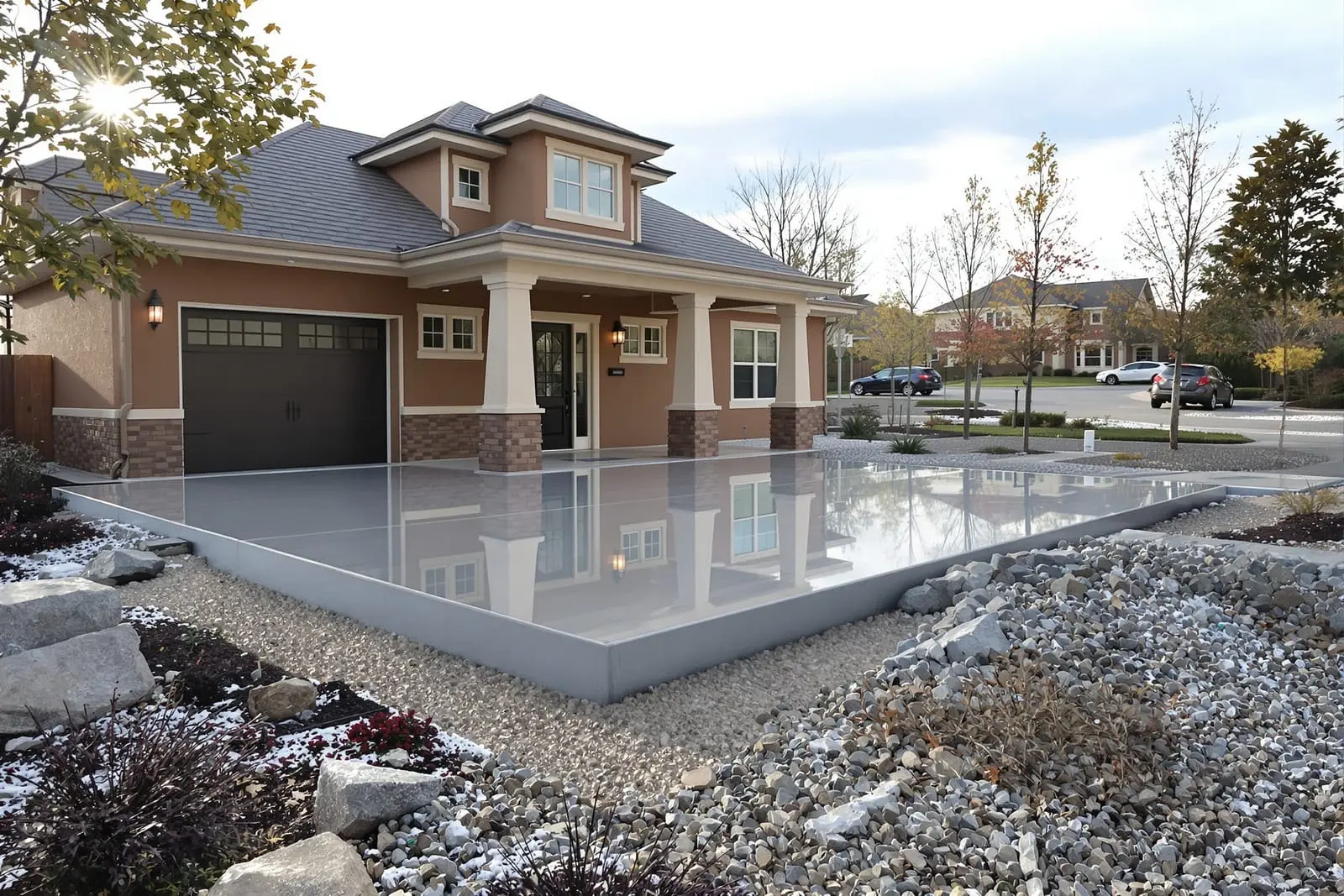
Get durable commercial concrete flatwork in Birmingham, AL for floors, pads, and exterior surfaces. We place and finish large slabs for warehouses, loading areas, and equipment pads. Our team follows proper jointing, reinforcement, and finishing practices to reduce cracking and downtime.
Vanguard Concrete Birmingham provides professional commercial concrete flatwork throughout Birmingham, AL and the surrounding area. Our licensed, insured crew delivers safe, clean, on-time work with a free estimate before anything begins. Call (205) 582-4879 or request your free quote.
Commercial Concrete Flatwork for Birmingham Businesses
Vanguard Concrete Birmingham specializes in commercial concrete flatwork that holds up to constant traffic, fork lifts, Alabama heat, and heavy rain. We focus on getting the slab right the first time, so you are not dealing with settled panels, ponding water, or cracked loading areas a year after the job is done.
Most of our calls in the Birmingham area come from business owners and facility managers who need new slabs for warehouses, retail pads, loading docks, dumpster pads, and parking lots, or who are tired of patching the same failed areas over and over. Our team looks at how your concrete will actually be used: the weight of your racks or equipment, the type of vehicles, drainage patterns on your site, and how often you will need to wash or clean the surface.
We handle projects across Jefferson and Shelby counties, including industrial parks, office complexes, churches, restaurants, and small business build outs. Whether you need a laser leveled interior floor for pallet racking or a durable exterior slab for deliveries and trash trucks, we plan the work around Birmingham soils, local building codes, and real traffic loads, not a generic one size fits all design.
How We Build Durable Commercial Slabs & Flatwork
A strong commercial slab starts with what you do before the concrete ever shows up. Vanguard Concrete Birmingham begins with subgrade evaluation. We check the existing soil with a probe rod and plate compaction tests when required. In many Birmingham locations, you get a mix of clay and fill material, which can hold water and move if it is not compacted properly. We remove any soft spots, organic material, and loose fill, then compact in thin lifts using plate compactors or rollers until we achieve a firm, uniform base.
Next comes base material. For most commercial flatwork, we install a layer of crushed stone, typically 57 stone or dense grade aggregate, to improve drainage and support. The thickness can range from 4 to 8 inches depending on soil conditions and load requirements. On interior slabs, we often use a vapor barrier on top of the stone to help control moisture movement through the slab, which matters for flooring adhesives and equipment.
Forming defines the final slab shape and elevations. We use straight, braced forms and set them to precise elevations so water sheds the right way, usually at a slope of at least 1 percent for exterior flatwork. Around doors and dock plates we fine tune the elevation to line up with thresholds and equipment so you do not end up with trip edges or water blowing under roll up doors.
For reinforcement, we use rebar grids or welded wire mesh depending on design, span, and expected load. Dumpster pads, dock aprons, and drive lanes usually get rebar tied in a grid, while light duty walkways may use mesh. On heavy duty applications, we may also incorporate dowels at joints and at connections to existing concrete to help transfer loads and limit differential movement.
Only after all of that is verified do we pour. We use commercial mix designs, typically 3000 to 5000 psi concrete, adjusted for temperature and placement conditions. During the pour, our crew consolidates concrete around reinforcement and along forms, then uses screeds and, for larger floors, laser guided equipment to achieve flatness. Finishing is timed carefully so the surface is closed and troweled without overworking, which can cause future scaling and dusting.
Finish Options, Joint Layout, and Surface Performance
Commercial concrete flatwork is not just a gray slab. There are real choices that affect how safe, cleanable, and durable your surface will be. Vanguard Concrete Birmingham walks you through finish options based on how the area will be used.
Interior warehouse and production slabs often get a machine trowel finish that is smooth, dense, and easier to keep clean. For areas that see oil or chemical drips, we may recommend a sealer after cure to help with maintenance. If you plan to install epoxy or other coatings, we adjust the finish profile so the coating can bond properly and coordinate timing so moisture levels in the slab are appropriate before coating.
Exterior flatwork like sidewalks, entries, loading docks, and drive lanes usually needs a slip resistant surface. For these, we commonly use a broom finish, sometimes with a slightly rougher texture on slopes or ramps. At storefronts and customer walkways, we can use a light broom with edging for a cleaner appearance that still provides traction in wet weather. For some Birmingham properties with branding needs, we have installed colored integrally dyed concrete or used stains on designated areas like plazas and outdoor seating.
Control joint layout is another critical detail. Concrete will crack as it cures and moves, so the smart move is to decide where that cracking happens. We space saw cut or tooled joints based on slab thickness and geometry, typically creating squares or rectangles with a length no more than 2 to 3 times the width. Around columns, corners, and changes in thickness, we plan joint patterns to reduce random cracking. For heavy traffic slabs we also use doweled contraction joints so the two sides of a joint move together under wheel loads.
We also consider long term performance details such as thickening slab edges where pallet jacks constantly turn, reinforcing around floor drains, and isolating slabs from building columns and walls with joint material to allow independent movement without transferring cracks.
What Affects Cost for Commercial Concrete Flatwork in Birmingham
When customers ask why one bid is higher or lower than another, the answer is usually in the details that are hard to see on paper. Vanguard Concrete Birmingham spends time walking the site and explaining what drives cost so you can make an apples to apples comparison.
Site conditions are a major factor. If your site has poor access, tight working areas in downtown Birmingham, or requires night or weekend work to keep your business open, that impacts labor and logistics. Unstable or wet soil that needs undercutting and additional stone base will add cost but is often cheaper than dealing with long term slab failure.
Design thickness and reinforcement level also matter. A 4 inch light duty sidewalk with wire mesh is a very different build from an 8 inch dumpster pad with rebar on chairs and dowels into an existing drive. For loading docks, heavy equipment pads, and warehouse floors with high racking loads, we typically recommend thicker slabs, higher strength mixes, and closer reinforcement spacing. Those upgrades cost more up front but prevent problems like curling, cracking, and joint failure under repetitive loads.
Finishes and accessories add another layer. Colored concrete, decorative saw cuts, embedded anchor bolts, floor drains, trench drains, and bollard footings all increase the complexity of layout and forming. On some Birmingham projects we also coordinate with plumbers and electricians to pour around conduit, sleeves, and pits, which requires extra layout time so everything ends up exactly where your equipment plans show.
Scheduling and phasing can also affect price. If we need to pour your flatwork in multiple mobilizations so your business can stay open or to coordinate with other trades, the extra trips and set up time influence the overall cost. We are upfront about these factors and lay out options so you can choose the combination of durability, schedule, and budget that makes sense for your operation.
Common Issues, Repairs, and How Vanguard Concrete Birmingham Helps You Avoid Them
Most of the slab repair calls we see around Birmingham fall into a few predictable categories: cracked or heaved panels from poor base prep, spalled joints where heavy forklifts are running, standing water near entries, and concrete that is flaking or dusty because it was finished incorrectly.
To avoid settlement and heaving, we do not skip soil prep or base compaction, even on smaller projects. Where drainage is a concern, especially on older commercial lots in low spots, we set grades so water has a way out and may recommend additional catch basins or re grading in problem areas. For dumpster pads and high impact zones, we often thicken the slab and increase reinforcement, then isolate the slab from surrounding pavement with proper joint material.
Joint damage is another common problem. If control and construction joints are not detailed with traffic in mind, forklift wheels and truck tires quickly beat them up. We handle this by using dowels where needed, making sure joints are properly cut within the right time window after placement, and, when specified, using joint fillers designed for industrial traffic. That spreads loads more evenly and reduces edge chipping.
When we are called to repair or replace failed commercial flatwork, we start by figuring out why it failed instead of just pouring new concrete over the same conditions. Sometimes the fix is as simple as replacing a few panels and improving drainage. Other times, we remove substandard base and build it back correctly. Our goal is to give you a long term solution, not another short term patch that will fail in the same way.
If you are planning new construction, an expansion, or replacing existing commercial concrete, Vanguard Concrete Birmingham can review your plans or help you develop a practical spec that fits your site and use. We coordinate with your GC, engineer, or architect as needed and keep you informed about schedule, access impacts, and curing times so you know when you can safely drive, park, or move equipment back onto the slab.
“
Professional commercial slabs & flatwork, done right the first time, quality materials, honest pricing, and results that last.
Vanguard Concrete Birmingham
Commercial Slabs & Flatwork Across Our Service Area