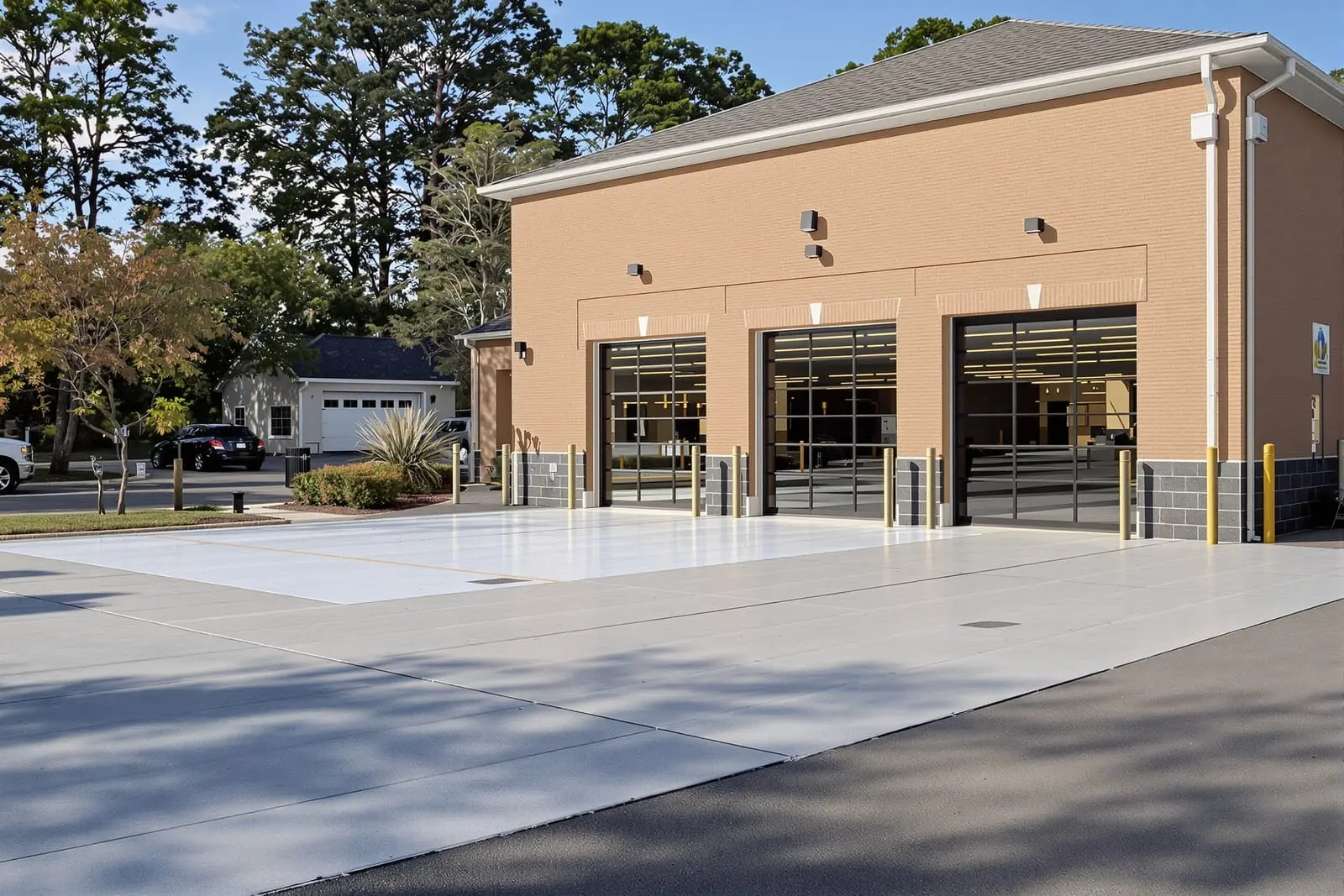
Keep shipping operations running smoothly with commercial concrete slabs in Birmingham, AL. We build loading dock aprons, ramps, and equipment pads that handle repeated truck and forklift traffic. Our heavy duty slabs reduce settlement and damage in high impact areas.
Vanguard Concrete Birmingham provides professional commercial concrete slab throughout Birmingham, AL and the surrounding area. Our licensed, insured crew delivers safe, clean, on-time work with a free estimate before anything begins. Call (205) 582-4879 or request your free quote.
Commercial concrete slabs and loading docks built for Birmingham businesses
A reliable commercial concrete slab is the quiet workhorse of your operation. It carries your building, your equipment, and in the case of loading docks, every pallet that moves in and out of your doors. Vanguard Concrete Birmingham focuses on slabs and loading areas that match what businesses here in central Alabama actually face: heat, humidity, sudden downpours, and clay soils that move if they are not handled correctly.
We listen first. Before we talk thickness or reinforcement, we ask how you use the space. Do you run pallet jacks or 18 wheelers. Do you stage loaded trailers overnight. Are you planning racking, cold storage, or sensitive machinery. Those answers change how we design the slab, from joint spacing and reinforcement patterns to surface finish and slope. This approach keeps you from overpaying for thickness you do not need, while avoiding the much more expensive problem of a slab that fails under real-world use.
Because we work all over the Birmingham area, we are familiar with local building requirements and practical access issues. Tight alleys in downtown, steep drives in Homewood, soft back lots in Bessemer, and industrial parks in Leeds each call for a different pour plan and equipment setup. Vanguard Concrete Birmingham brings that field experience to every project, so the slab design on paper matches what can actually be built efficiently on your site.
How we design commercial concrete slabs and loading docks
Commercial slab work is not just ordering a concrete truck and spreading it around. We start with the subgrade. Our crews evaluate your existing soil and base material, then cut, fill, and compact until we have uniform support underneath. In many Birmingham sites the native red clay holds water and swells and shrinks, so we often include a layer of compacted crushed stone to create drainage and a more stable base.
Thickness and reinforcement come next. For interior commercial concrete slabs with light forklift use, we typically see 5 to 6 inch slabs, while busy loading docks and drive lanes might need 7 to 8 inches or more, depending on axle loads and frequency of traffic. Reinforcement might be welded wire mesh, #4 or #5 rebar on a grid, or in some cases a combination of both. For heavy truck docks we often tie the slab into grade beams or thickened edges so the slab does not break down at the concrete and asphalt transition.
For loading docks specifically, we pay close attention to slopes and elevations. The dock face, approach, and building floor must line up with your dock levelers and trailers. We coordinate with your dock equipment supplier to hit required dimensions, bumper locations, and curb heights. We typically build a slightly steeper approach apron outside the dock, so water runs away from the building and does not puddle where your team is working. Simple details like this make day-to-day operations smoother and reduce long-term maintenance.
Concrete mix, joints, and finishes that hold up to Alabama weather
Not all concrete mixes behave the same when it is 95 degrees and humid. Vanguard Concrete Birmingham works with local batch plants to specify mixes that suit your pour time, slab thickness, and finishing needs. For most commercial concrete slabs and loading docks, we use a mix in the 4000 to 5000 psi range, with air entrainment as needed for exterior slabs that take occasional freeze cycles. In hot weather we may schedule earlier pours, use set retarders, and add extra finishing crew so the surface is shaped and textured before it gets away from us.
We design control joint layouts to manage cracking instead of pretending cracks will never form. For a typical warehouse slab, joints might be cut at 10 to 15 foot spacing, adjusted for slab thickness and reinforcement. On loading dock aprons and high traffic areas we may tighten that spacing and use doweled joints so forklifts and truck tires roll smoothly without pounding the edges. Early-entry saw cutting, usually within several hours of finishing, helps control where shrinkage cracks appear.
Surface finish depends on your use. Interior slabs for racking and forklifts often get a smooth hard trowel finish, sometimes with densifiers or sealers if you need dust control or easier cleaning. Exterior loading docks usually get a broom finish that provides traction when it rains. Where trailers back in at an angle or where there are slopes, we might use a slightly heavier broom or textured pattern so tires and boots grip better, even when there is oil or water on the slab.
What affects the cost of a commercial concrete slab in Birmingham
Business owners often ask why two slabs that look similar on paper have very different prices. The cost of a commercial concrete slab or loading dock is driven by several specific factors. The first is access and site conditions. If our trucks can back right up and the site is already roughly graded, your price will be lower than a tight, downtown site that requires pumping concrete over a building or significant demolition before we start.
Next is slab thickness and reinforcement. Concrete and steel are major cost components. An extra inch of thickness across a large dock or warehouse adds a lot of volume. Likewise, a simple wire mesh slab will cost less than a heavily reinforced, doweled, and thickened edge design. Our job at Vanguard Concrete Birmingham is to match the slab to your actual loads and risk level, not just to the absolute minimum in the code or an overly conservative guess.
Timing and phasing also matter. Pouring a large slab in one mobilization, with good access for trucks, is more efficient than breaking it into many small phases to work around operations or other trades. Where your business cannot shut down, we can phase the work in strips or sections, but we will walk you through how that affects labor time, concrete delivery, and ultimately cost, so you can decide if speed or budget is more important.
Finally, options like vapor barriers, integral curbs, drains, trench systems, or specialty coatings add to both material and labor costs. We itemize these clearly, so you see what each feature costs and can prioritize what really protects your equipment and inventory.
Common problems with loading docks and how we prevent them
Loading dock and commercial slab failures show up in a few predictable ways: broken slab edges where trucks drop off, standing water against the building, door thresholds that heave or settle, and spalling at the joint between interior slabs and exterior aprons. Because we see these issues at older Birmingham facilities, we design new work to avoid the same traps.
One big cause of failure is poor base preparation. If the soil under the slab is not compacted evenly, heavy truck wheels will find the soft spots and the slab will crack or tilt. We use mechanical compaction in thin lifts, check with density tests when needed, and refuse to pour on questionable subgrade, even if it means another day of prep. This is far cheaper than trying to lift or replace a settled slab later.
Water control is the next concern. Birmingham storms can drop a lot of rain in a short period. If the apron outside your dock is flat or sloped toward the building, water can attack joint sealant, migrate under the slab, and lead to erosion or freeze-thaw damage during cold snaps. We introduce positive slope away from the building and, when appropriate, install trench drains or area drains that tie into your storm system.
For existing docks that are already damaged, Vanguard Concrete Birmingham can demo and replace sections, install new thickened edges where trailers impact repeatedly, and use dowels or keyways to tie new concrete to old. When we repair rather than replace, we focus on proper bonding surfaces, joint alignment, and improved drainage, so the repaired section does not just inherit the same problems that caused the original failure.
Planning, permitting, and scheduling your slab project
A commercial concrete slab or loading dock project is as much coordination as it is concrete. We start with a site visit to review your layout, traffic flow, and any existing drawings you have. If you are expanding or reconfiguring a facility in Birmingham, we can work with your engineer or architect, or help connect you with one, to develop drawings that will satisfy local requirements and your insurer.
For projects that require permits, structural review, or inspections, we help line up the documents the city or county asks for and schedule pours around inspection windows. This reduces surprises and downtime. On occupied sites, we coordinate with your operations team to stage work in ways that keep at least some doors or access lanes open whenever possible.
Before construction, we give you a clear sequence: excavation and base prep, formwork and reinforcement, utility coordination for any drains or conduits crossing the slab, the concrete pour itself, and curing time. For heavy use, we typically recommend waiting several days before light traffic and up to 7 days or more before full truck loading, depending on the mix and ambient conditions.
Throughout the job, Vanguard Concrete Birmingham provides a single point of contact you can reach for schedule updates or changes. Our goal is to deliver a commercial concrete slab or loading dock that fits your business, your site, and Birmingham conditions, without unnecessary disruption to your daily operations.
“
Professional loading docks & commercial slabs, done right the first time, quality materials, honest pricing, and results that last.
Vanguard Concrete Birmingham
Loading Docks & Commercial Slabs Across Our Service Area